

 INGROWN TOENAILS
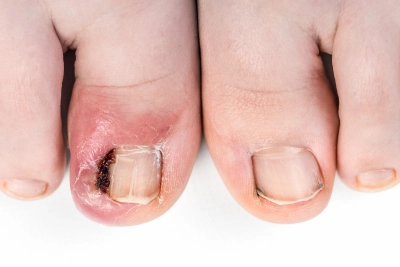
INGROWN TOENAILS (INGUIS INCARNATUS) MOSTLY AFFECT THE BIG TOE. THE INGROWN TOENAIL PRESSES INTO THE NAIL BED CAUSING PAIN OR INFLAMMATION. POSSIBLE CAUSES INCLUDE PREDISPOSITION, TIGHT SHOES, OR INCORRECT NAIL CUTTING.
READ ABOUT THE CAUSES AND TREATMENT OPTION HERE.
Photo: © Stephanie Eichler - stock.adobe.com
-
What are ingrown toenails? What are the symptoms?
-
What are the causes?
-
What type of treatment is available?
-
How do I prevent ingrown toenails?
-
How long does full recovery take?
-
Is there any risk from an ingrown toenail?
What are ingrown toenails? What are the symptoms?
An ingrown toenail presses on the nail bed, causing inflammation and swelling. The irritation causes granulation tissue to form and bacteria can enter the damaged and inflamed skin, which leads to further inflammation.
What are the causes?
Tight shoes or incorrect nail-cutting techniques encourage the development of ingrown toenails. Cutting toenails into an oval or rounded shape at the edges can cause pressure when wearing tight shoes, which often leads to the development of an ingrown toenail.
Some patients have a familial predisposition for ingrown nails. A wider nail bed can increase the risk of ingrown toenails.
What type of treatment is available?
 First and foremost, trained medical podiatrists are a good place to start. We have a team of trained professionals in our practice. They offer the following conservative treatment options in our center in Vienna:
Tamponades: The edge of the nail is carefully lifted, and a sterile compress strip is placed between the nail and the skin as a cushion.
Adhesive tape: Tape is attached so that it pulls the inflamed skin on the side of the nail away from the edge of the nail.
Nail clips: These wire clips are placed on the nail and hooked behind one or both side edges of the nail by a podiatist. Pulling the brace lifts the nail a little.
If the problem is not brought under control through conservative measures such as braces, taping and tamponades, it is advisable to see a specialist dermatologist or surgeon.
There are several ways to surgically treat an ingrown toenail. In the case of minor interventions, the inflamed tissue on the side of the nail is removed (nail wall resection). This gives the nail more space. Sometimes only the ingrown nail edge is cut away (wedge resection).
If ingrown nails repeatedly cause problems, there is the possibility of nail narrowing. There are two options for this:
A nail wedge excision (Emmert plastic) is used to remove the affected nail and its growth zone (matrix). After the operation, the nail grows back smaller and, as a rule, there is no renewed ingrowth.
Another option is phenol caustic. With this method, the growth zone (matrix) is destroyed with phenol - a strong acid. This also leads to a reduction in the size of the nail. This procedure can be easily carried out in the doctor’s surgery and, according to studies, has a lower chance of recurrence than after just surgical intervention.
Local anaesthetic is usually sufficient for these types of treatment. The anaesthetic is injected into the toe on both sides temporarily paralysing the nerves. To prevent the area from bleeding too much during the operation, a rubber band is tied around the toe.
Possible complications during and after an operation are infections or healing complications of the wound, problems with nail growth or bleeding.
Book your appointment here.
How do I prevent ingrown toenails?
The right footwear and optimal cutting of the nails are important. In the event of an acute occurrence, you can first try to cleanse the painful area in a warm, soapy or tannin foot bath and soak for about 10 to 20 minutes. In some cases, iodine baths can also be taken - but with caution, as iodine can interfere with wound healing. The affected foot should be dried thoroughly after the bath. Antiseptic and anti-inflammatory ointments (iodine) prevent infections and can soothe the skin.
How long does full recovery take?
Since nails grow only slowly, treatment takes a certain amount of time. Those affected should therefore be patient, because depending on the findings and treatment method, it can take several weeks, sometimes even months, until the nail grows normally again. Comfortable shoes and the right cutting technique are important even after successful treatment.
Is there any risk from an ingrown toenail?
An ingrown toenail is very painful. The inflamed area can also serve as an entry point for other germs and subsequently lead to an infection. Elderly people in particular, as well as diabetics, are at risk because wound healing is poorer for them - partly due to the increased sugar.
Dr. Gábor Bali is one of our physicians with extensive experience in the surgical treatment of ingrown toenails (phenol cauterization).
FAQ – Ingrown Toenail
Here you will find answers to the most frequently asked questions about ingrown toenails, their causes, symptoms, and modern treatment options such as nail braces and minimally invasive surgical techniques that finally provide effective relief.
-
What is an ingrown toenail?
An ingrown toenail occurs when the side of the nail grows into the surrounding skin, causing pain, redness, swelling, or even infection. The big toe is most commonly affected.
-
What causes an ingrown toenail?
Typical causes include incorrect nail trimming (too short or rounded), tight shoes, natural nail curvature, injuries, or toe deformities. Excessive sweating or a genetic predisposition can also contribute.
-
What symptoms are typical?
Common symptoms include sharp pain while walking, tenderness along the nail edge, redness or swelling, and sometimes pus formation, indicating a bacterial infection.
-
How is an ingrown toenail treated?
• Early stages: Pressure relief, antiseptic foot baths, thinning the nail edge; professional foot care recommended.
• Moderate cases: Nail brace (3TO brace) combined with professional foot care.
• Severe/chronic cases: Minor surgical procedure (phenol cauterization). -
What is a 3TO nail brace?
The 3TO brace gently lifts the nail, relieves pressure points, acts like a “drawbridge,” and guides the nail back to a normal shape. It is non-invasive, nearly painless, and daily activities, sports, and shoes are immediately possible.
-
What is phenol cauterization?
Phenol cauterization is a minimally invasive procedure in which a small part of the nail matrix is removed under local anesthesia and treated with phenol. This prevents the nail from regrowing in that area. It is very effective with a low recurrence rate.
-
Can an ingrown toenail go away on its own?
Early stages may improve temporarily, but symptoms often persist, return, or worsen. Early treatment helps prevent infection and often avoids surgery.
-
Which appointment should I book?
In our specialized clinic in Vienna, we offer several options for the treatment of ingrown toenails.
• Foot care (EUR 75): For moderate symptoms. Assessment, full foot care, advice. No prescriptions possible.
• Medical consultation (EUR 170): For severe cases or infections. Dr. Peinhaupt, Dr. Kapsch, and Dr. Bisschoff specialize in ingrown toenails.
By Dr. Johannes Bisschoff
Published on 18.11.2025