

 Laser treatment: targeted treatment for skin changes
Our practice in Vienna is the Austrian reference centre for Asclepion Lasers. We work with current laser systems and also train other doctors in laser technology.
Our lasers treat many skin changes: small blood vessels on the face or body, wrinkles, acne scars, crow's feet, cholesterol deposits (xanthelasma) and other unwanted skin changes. Our picolaser can also remove age spots and tattoos gently. Treatment causes little pain and leaves little or no scarring. Results look natural and the skin heals quickly.
Contents
-
What is a laser and which lasers are available at 'Medizin am Hauptbahnhof'?
-
What is the Erbium Dermablate (MCL31) used for?
-
What is Deka DuoGlide used for?
-
What is the QuadroStarPROYELLOW used for?
-
What is the DEKA Again PRO used for?
-
What is the Quanta Systems Discovery Picolaser used for?
-
What other treatments can be done with the available lasers?
-
What should you pay attention to when treating with a laser?
-
What side effects can occur?
-
What costs do you have to reckon with?
What is a laser and which lasers are available at 'Medizin am Hauptbahnhof'?
Laser stands for "light amplification by stimulated emission of radiation". Laser beams are electromagnetic waves, in other words amplified light. Most are invisible, but some wavelengths can be seen. The wavelength decides which skin changes the laser acts on. The target can be red colour (small vessels, nail fungus), dark colour (tattoo removal, hair removal) or water (scars). To remove skin lesions, the laser targets the water in the tissue. The beam enters the top layer of tissue and, depending on the settings, hits the chosen target: water, vessels, colour pigments, hair roots or nail fungus.
We work with several lasers that act in different ways:
- Erbium Dermablate (MCL31)
- DuoGlide
- QuadroStarPROYELLOW
- Again PRO by DEKA
- Discovery Picolaser by Quanta Systems
We are happy to advise you on the right laser for your needs.
What is the Erbium Dermablate (MCL31) used for?
The erbium laser (MCL31 Dermablate) treats wrinkles, acne scars, crow's feet, cholesterol deposits (xanthelasma) and other unwanted skin changes. It removes skin very precisely and is well suited to skin rejuvenation. It is a gentle alternative to traditional dermabrasion, which sands tissue away mechanically, and to electrocautery, which burns it.
The laser is aimed at the area to be treated. It enters the top layer of skin and is absorbed by the water in it. The water evaporates instantly and carries tiny particles of tissue away with it. You hear a slight popping sound. Layer by layer, the tissue is removed very finely and precisely. Unlike electrocautery, the surrounding skin stays intact. In fractional ablation, special optics split the laser light into many fine beams. This creates a grid, and much of the skin between the micro spots is left untreated. The tissue heals very quickly from these healthy islands of skin. The skin becomes firmer, new collagen forms and it looks fresher.
How long does it take? That depends on the type and size of the area. Small wrinkles, scars or small moles take a few minutes. A fractional ablation (skin rejuvenation) of the face takes about half an hour. One session is usually enough. For scars, tattoo removal or deeper skin problems, several sessions are usually needed. We discuss this with you beforehand.
Book your appointment here
What is Deka DuoGlide used for?
The DuoGlide works with two wavelengths. As with the erbium laser (Dermablate MCL31), the ablative CO2 wavelength of 10,600 nm is absorbed by the water in the tissue, producing heat that removes the skin lesion. It produces more heat than the erbium laser, so it stops bleeding at the same time and stimulates collagen more strongly. It can also be used fractionally: tiny holes are made in the skin, and the injury and heat stimulate collagen. The second wavelength (Er:Glass) is in the infrared range at 1,540 nm and brings heat deep into the skin.
This heat also stimulates new collagen, but at 1,540 nm the skin is not removed and there is no downtime. It is a gentle option for scars and acne.
One of our favourite treatments with this laser is CoolPeel®. It gives:
- Skin rejuvenation
- Reduction of wrinkles
- Refinement of pores
Downtime is short, just 1 to 3 days depending on the energy used. If you have the treatment on a Friday, for example, you can start the new week without redness after the weekend.
The DuoGlide is also used for vaginal health. Its two wavelengths reach deeper tissue. The vaginal laser can relieve symptoms in women with lichen sclerosus, vaginal itching, pain during intercourse and incontinence.
What is the QuadroStarPROYELLOW used for?
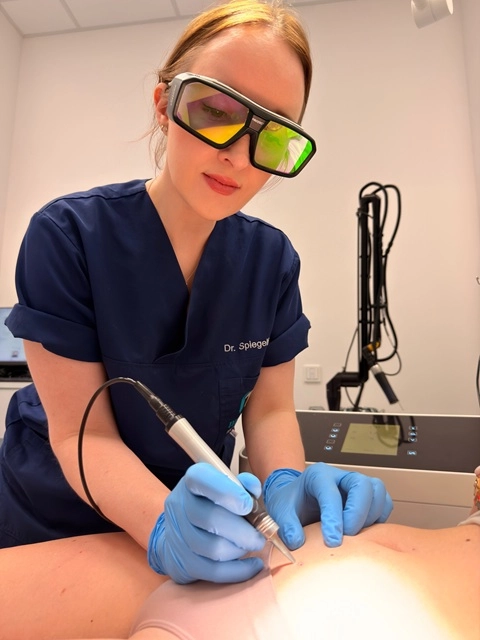 With its yellow wavelength of 577 nm, the QuadroStarPROYELLOW is considered the gold standard for treating blood vessels, such as rosacea, couperose, telangiectasia, spider naevi, cherry angiomas, port-wine stains (haemangiomas) and red spider veins. Treatment is quick, effective and safe. Compared with conventional KTP lasers (532 nm), it acts more precisely on the vessels and so has fewer side effects.
The laser beam is aimed at a visible vessel. Its target is the red blood pigment haemoglobin. The laser heats the vessel and damages the vessel wall, so the vessel seals and is broken down. In most cases the vessels are no longer visible after one treatment.
Because melanin absorbs this wavelength less than 532 nm, darker skin types can be treated too. For larger areas, the QuadroStarPROYELLOW has a scanner with built-in skin cooling as well as the standard handpiece. You feel less heat, and the treatment is more comfortable.
What is the Again PRO by DEKA used for?
The Again PRO works with two wavelengths that are considered the gold standard for many treatments in dermatology and aesthetic medicine: alexandrite 755 nm and Nd:YAG 1064 nm.
The laser also has strong cooling, which patients find pleasant.
This makes it very good for fast hair removal with little pain, and hair removal is possible all year round, not just in the darker months. We also use it for vascular lesions, nail fungus treatment and skin rejuvenation, especially for deeper and larger vessels such as spider veins or haemangiomas. The Nd:YAG 1064 nm wavelength is also very well suited to treating nail fungus, where laser treatment is an important option.
What is the Quanta Systems Discovery Picolaser used for?
We use the Quanta Discovery Pico mainly for tattoo removal. It works with wavelengths of 1064 nm, 694 nm and 532 nm, so it can remove tattoos in all colours as well as permanent make-up. It belongs to the new generation of picosecond lasers. Its very high peak power and ultra-short pulses improve results in tattoo removal.
The laser breaks up pigment in the skin very precisely. The pigment absorbs the light from the picosecond pulses and heats up to over 900 °C. It expands extremely fast, which creates a pressure wave that shatters the pigment. Scavenger cells (macrophages) take up the fragments, and the lymphatic system carries them away. This is called the photoacoustic effect: the particles are literally "pulverised".
The picosecond laser can even break up the tiny ink particles in black tattoos. Because these particles are so small, they sometimes do not respond to Q-switched nanosecond lasers. The picosecond pulse turns them into fine "dust" that the immune system can clear more easily. With 532 nm and 1064 nm in the picosecond range, the Discovery PICO can treat different tattoo colours and both superficial and deeper pigment changes.
Energy density and pulse duration can be set over a wide range, so we can adapt the treatment to you.
We also use the Discovery Pico for pigment spots, age spots and freckles, and to tighten and rejuvenate the skin by stimulating collagen.
What other treatments can be done with the available lasers?
Many people are bothered by blemishes and small wrinkles. Make-up can cover them up. To tackle the cause, a chemical peel can help. Laser peeling is a good alternative for blemished skin or small wrinkles. Active ingredients also penetrate better afterwards. In cosmetic treatments we use this to bring in ingredients that tighten the skin and reduce pigmentation. Treating the face takes about 20 minutes. We recommend one session to start with, then more as needed. The skin is slightly red afterwards, and after a few hours the face looks fresh.
Carbon peeling with the picolaser is very popular on social media right now. A carbon solution is applied to the skin. The laser is absorbed by the carbon and removes the top layer of skin, which improves skin texture and tone.
Carbon peeling works especially well for acne, acne scars, large pores and uneven skin texture. It can also even out skin tone and reduce pigment spots.
Usually several sessions are needed. The treatment is quick and painless. The skin is usually a little red afterwards, with no long-term effects.
To be safe and effective, carbon peeling should be done in a dermatology practice.
CoolPeel® is very popular with our patients. The CO2 laser stimulates collagen with very short downtime. It refreshes the skin, reduces wrinkles and refines skin texture. It suits anyone who wants a natural result and simply wants to look fresher.
The vaginal laser is a gentle treatment for lichen sclerosus, incontinence, vaginal dryness and pain during intercourse.
Some men are bothered by pearly penile papules. This harmless change can also be removed well with a laser.
What should you pay attention to when treating with a laser?
Before any laser treatment, besides cleansing the skin, a doctor must make a diagnosis. At the consultation we assess your skin type, discuss how likely the treatment is to succeed and rule out contraindications. Individual moles can usually be removed straight away. How painful the treatment is depends mainly on how extensive it is. Local anaesthetic is possible for removing moles, but is rarely needed for peels or scar treatment. For sensitive patients, a numbing cream beforehand is usually enough, followed by a soothing cream (e.g. aloe vera) afterwards.
It is important to use very consistent sun protection for four to six weeks afterwards.
What side effects can occur?
Mild side effects such as redness disappear within a few days. With some treatments, light crusting is a normal part of healing. In dark skin types, and especially with sun exposure, dark marks can appear after inflammation (post-inflammatory hyperpigmentation, PIH). So always use consistent sun protection. The colder months are especially good for laser treatment.
What costs do you have to reckon with?
For a single wrinkle or a nail-sized mole, plan on around 250 euros (incl. consultation), plus around 100 euros for each additional mole. A fractional treatment of the face costs up to 850 euros. Treating vessels on the face (cheeks and nose) costs around 400 to 450 euros. For cherry angiomas (haemangiomas) and tattoos, the price depends on the number and size of the area. Hair removal with the Again PRO costs between EUR 70 (upper lip or chin) and EUR 530 (full legs) per session, depending on the area. You can find more details here. All prices are a guide only. You are welcome to book a consultation.
Book your appointment here
FAQ: Laser
Here you will find answers to the most important questions about laser.
-
What laser treatments do you offer?
We provide the full spectrum of dermatological laser treatments: scars, pigmentation, melasma, sun damage, rosacea, couperose, laser hair removal, skin rejuvenation, nail fungus, warts, tattoos, vein treatments and more. Our clinic operates one of the most advanced laser portfolios in Austria.
-
What type of laser devices do you use?
We exclusively use modern, medical-grade laser systems manufactured in Europe. These include fractional lasers, ablative and non-ablative systems, modern picosecond lasers, vascular lasers, pigment lasers, YAG lasers, Alexandrite lasers and advanced multi-platform devices.
-
Are your lasers safe?
Yes. All devices comply with strict European medical safety standards. They are regularly maintained, quality-checked and operated only by trained dermatologists.
-
What can I expect during a laser session?
We begin with a detailed skin evaluation to choose the optimal laser and discuss all options with you. Treatment can then be sceduled. Treatments are typically quick, precise and minimally invasive. Cooling or topical anesthetic may be used depending on the indication.
-
Does laser treatment hurt?
Most people describe the sensation as warm or lightly prickling. With modern cooling systems and experienced application, the treatment is generally very well tolerated.
-
How many sessions will I need?
The number of sessions depends on your skin type and the condition being treated. Pigmentation and vascular issues often require 1–3 sessions, scars 3–6, skin rejuvenation treatments are typically performed in intervals.
-
What should I do after the treatment?
Sun protection is essential. Avoid heat, saunas and intensive sun exposure for several days. We provide personalized aftercare instructions depending on the laser used.
-
Why choose Medizin am Hauptbahnhof Vienna?
Our clinic offers:
-
the most advanced European laser technology,
-
complete coverage of all dermatological laser indications,
-
highly trained dermatologists,
-
exceptional safety standards with EU-certified systems,
-
fully individualized treatment plans.
We combine cutting-edge technology with deep medical expertise.
-


